
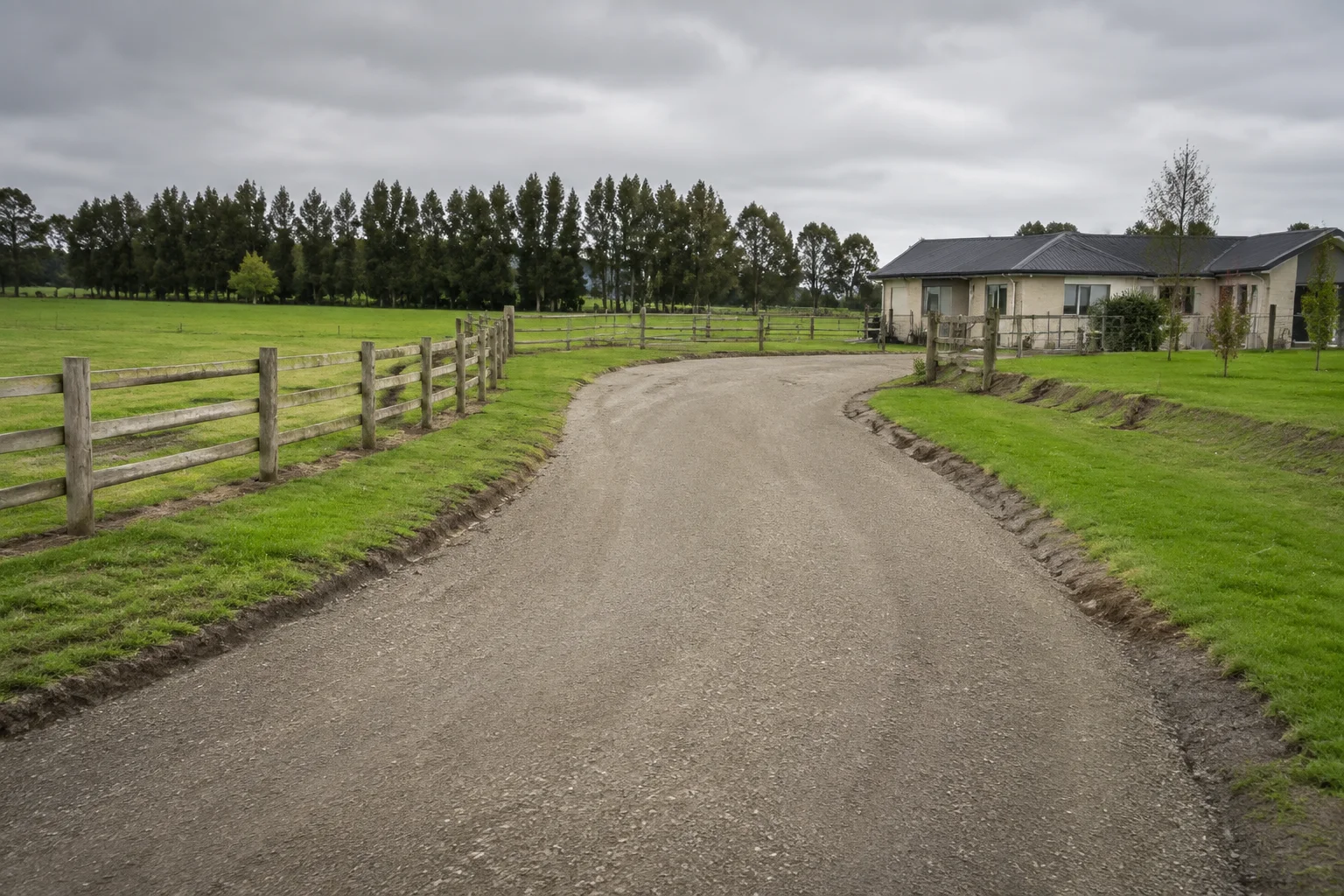
Driveway Installation
New driveways built end to end across Christchurch, from excavation and base through to the finished concrete or asphalt surface, drainage and edges.
View serviceDriveways, Access & Civil Groundworks
Excavation and sub-base preparation for new or replacement driveways, shaped and compacted to the finished levels the surface needs — as a standalone job or as the first stage of a full install.
03 661 7200Your site. A clear next step.
A driveway that lasts starts with proper excavation. Christchurch Earthworks carries out Christchurch driveway excavation for new driveways, replacements, and access upgrades across Canterbury. We remove old surfaces, dig to the correct depths, and shape the formation to give your driveway the right falls for drainage. Our team accounts for existing services, boundaries, and levels at the road entrance, keeping the work accurate and compliant. Spoil is removed efficiently, leaving the area ready for base course, concrete, asphalt, or pavers. Good excavation prevents sinking, cracking, and water pooling later on. Whether you have a short residential driveway or a long rural access, we have the right machines for the job. Contact Christchurch Earthworks today for a driveway excavation quote.
Tell us what you want to achieve, where your site is and when you would like to start. Include any plans, access constraints or measurements that will help us understand the work.
Recognise your project
Define the work
An existing driveway is broken out and removed where the new one is replacing it. Building over a failed surface carries the old problem forward, so it comes out rather than being covered up.
The driveway line is excavated to the formation level the finished surface and base depth require. Getting this depth right is what leaves room for a base thick enough to carry the vehicles using it.
Geotextile fabric is laid over soft or variable ground before aggregate goes down. The fabric stops the base migrating into the subgrade, which is a common reason driveways sink in patches.
Aggregate sub-base is supplied, placed and compacted in layers to the depth the loading calls for. This is the part that carries the driveway, and it is the most expensive place to cut a corner.
Cross-falls and longitudinal grade are shaped in so the driveway sheds water rather than holding it. Ponding, ice in winter and water tracking toward a garage all trace back to falls set wrong.
Where a culvert or pipe crosses the driveway line, we coordinate that work into the excavation sequence. It is far cheaper to deal with a crossing before the base goes in than to open it up afterwards.
Edges are prepared for kerb, edging or boundary features so the finished surface has something to work against. Unsupported edges are the first part of a driveway to break away under a wheel.
The prepared driveway is handed over at the correct finished level, allowing for the thickness of the surface course. That handover level is agreed in advance so the surfacing crew is not left adjusting.
Why work with us
Sub-base depth is assessed from the ground conditions and the vehicles the driveway must carry. This is the most expensive corner to cut and the one that fails first.
Geotextile goes over soft or variable subgrade so the base does not migrate into it. That migration is why driveways develop patchy dips after a few winters.
Cross-fall and longitudinal grade are shaped so water leaves the driveway and reaches somewhere it is allowed to go, rather than tracking toward a garage or a neighbour.
We hand over at the finished level their surface thickness requires, agreed in advance. Both trades working from the same levels is what avoids rework on the day.
Culverts and pipes crossing the driveway line are sequenced into the excavation. Retrofitting a crossing through a finished driveway costs several times what it costs now.
This service is the groundworks alone, which suits builders with a surfacing contractor lined up. We also build the finished driveway if you would rather not coordinate two trades.
Working conditions
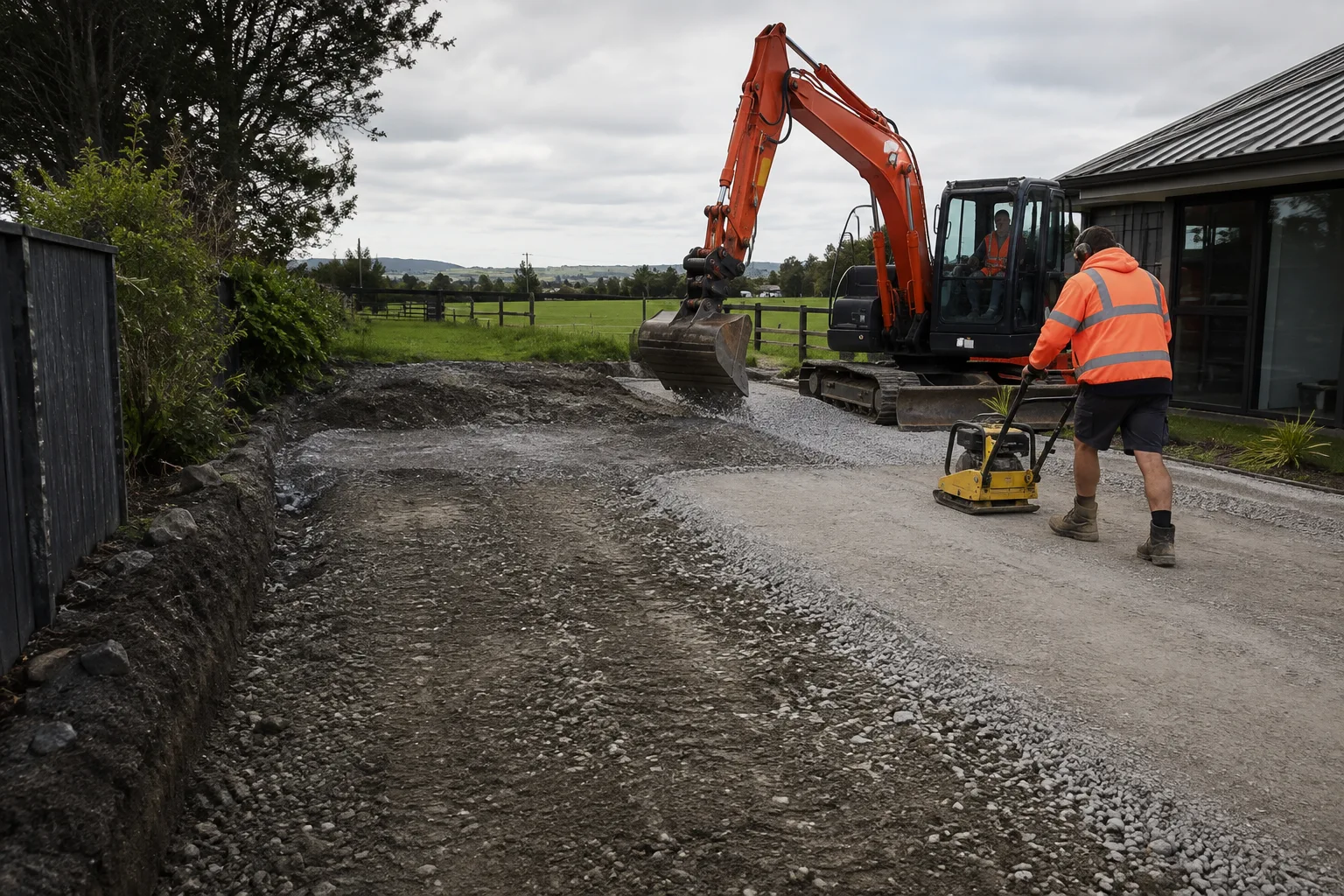
We select excavators, rollers and compaction equipment to suit the size and access of each site, from tight residential driveways to longer rural accessways. Machinery is scaled to the job rather than fixed to one setup, and we can advise on likely access needs when you get in touch.
Excavation and base preparation typically take a few days depending on driveway length and ground conditions, with additional time if an existing surface has to be removed first. Expect some noise and dust while machinery is on site, and your vehicle access may be restricted during the works. We work around weather, since wet ground can affect compaction quality.
Get the detail right
A driveway is only as good as what's underneath it. Skipping proper sub-base depth, fabric or compaction is one of the main reasons driveways crack, sink or pond within a few years. Getting formation levels and falls right the first time also avoids costly rework once concrete or asphalt is down.
We can. This page covers the excavation and base preparation on its own, which suits builders and anyone who already has a surfacing contractor lined up. We also lay concrete and asphalt driveways ourselves — see our driveway installation and asphalt driveways services if you would rather one crew did the whole job.
It depends on the ground conditions and what the driveway needs to carry, from a light passenger car to farm vehicles or trucks. We assess this on site rather than applying one standard depth to every job.
Yes, breaking out and removing an existing surface is usually the first step when we're replacing a driveway rather than building a new one.
We can work through most of the year, but wet winter conditions can slow excavation and affect how well the sub-base compacts, so we plan around forecast weather where possible.
We can excavate for and install a culvert pipe as part of the driveway build if water needs to pass underneath it. Broader drainage design is coordinated with the relevant specialist where needed.
This depends on the property and whether the driveway connects to a road corridor. We recommend confirming requirements with your council before work starts, and can work in with any conditions that come back.
The next part of your project
New driveways built end to end across Christchurch, from excavation and base through to the finished concrete or asphalt surface, drainage and edges.
View serviceRepairing cracked, sunken, potholed and ponding driveways across Christchurch, starting with why the surface failed rather than just patching the top.
View serviceAsphalt driveways laid across Christchurch on a base built to carry them, plus resurfacing and overlays where the existing driveway is still sound underneath.
View service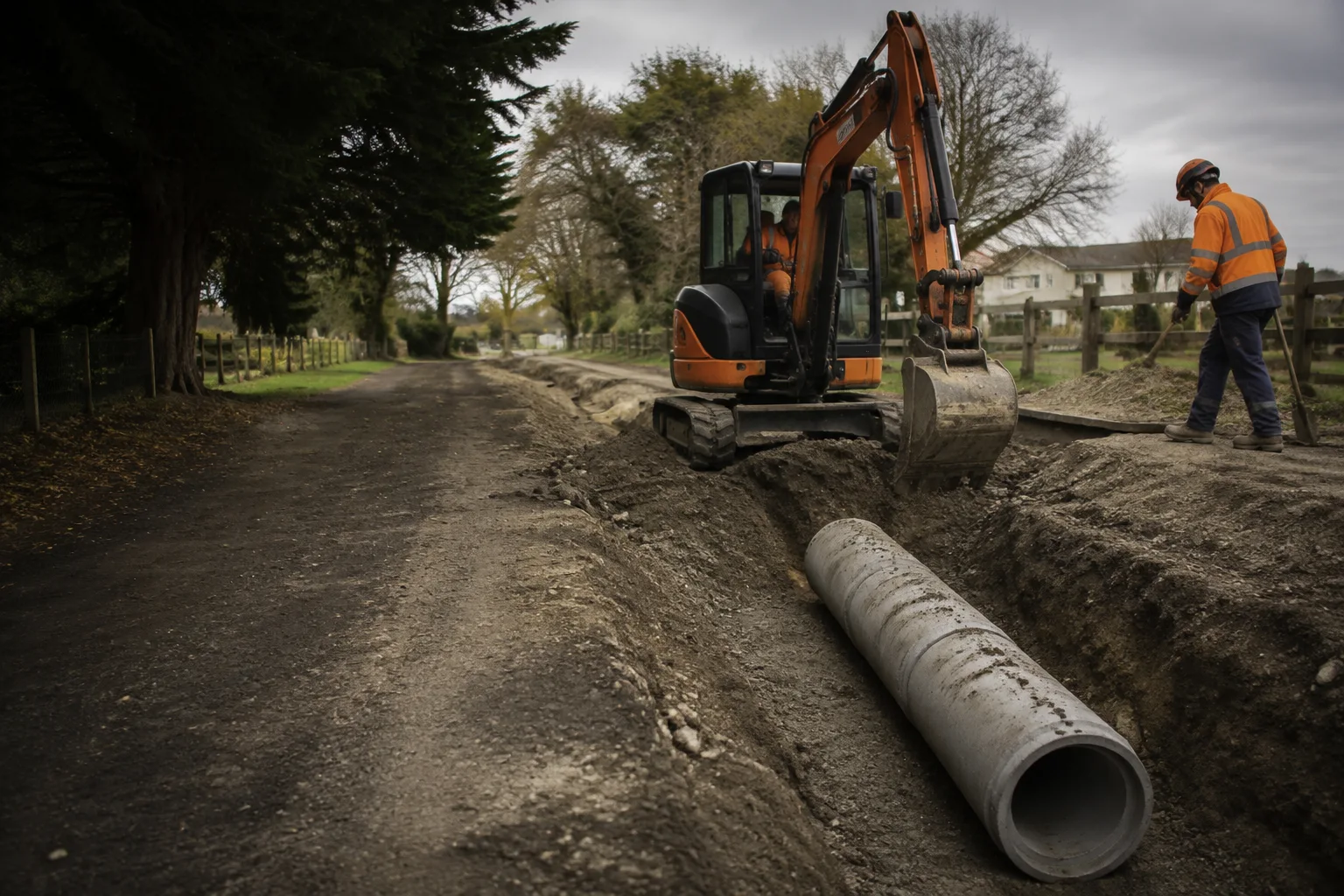
Excavation and pipe-laying for driveway culverts, keeping water moving under an access way instead of pooling or washing it out.
View serviceTell us about your project and we will come back with clear next steps — no pressure, no jargon.
YOUR SITE. THE NEXT CHAPTER.
Start with your suburb, a few site details and what you want to build.
Plan your project