Bulk Earthworks & Site Cut-to-Fill
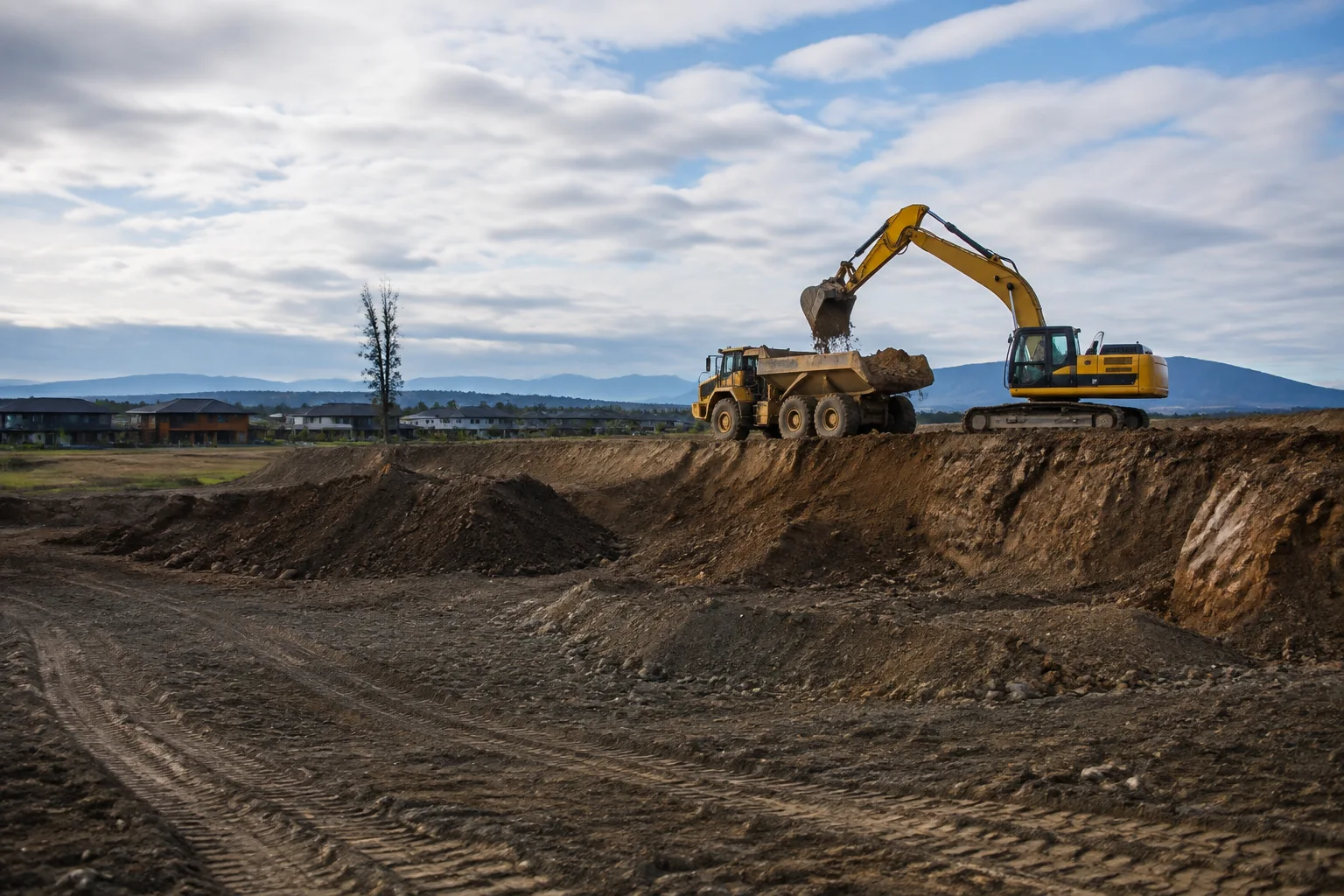
Cutting, filling and re-shaping land to bring a site to the levels your build or subdivision design calls for.
View serviceAccess & machinery
A general guide to how access, ground conditions, reach and job type determine the right size of digger for a project, and what to check before requesting a quote.
03 661 7200Your site. A clear next step.
Christchurch Choosing the Right Digger/Excavator Size for Your Project looks at how access, ground conditions, reach and job type determine the right size of digger, and what to check before requesting a quote.
Tell us what you want to achieve, where your site is and when you would like to start. Include any plans, access constraints or measurements that will help us understand the work.
Access & machinery
Updated 2026-09-06
Choosing a digger is a balance rather than a matter of bigger being better. A machine that is too large for a site may simply not fit through a gate or between a house and a boundary fence, while one that is too small can take far longer to shift the same volume of material, or lack the reach to work safely from a stable position. Getting the size right affects how efficiently a job runs, how much ground protection is needed, and how much disruption a site experiences during the works.
This is very much a site-specific decision, which is why a good quote usually starts with questions about access and ground conditions rather than a fixed price list.
Access & machinery
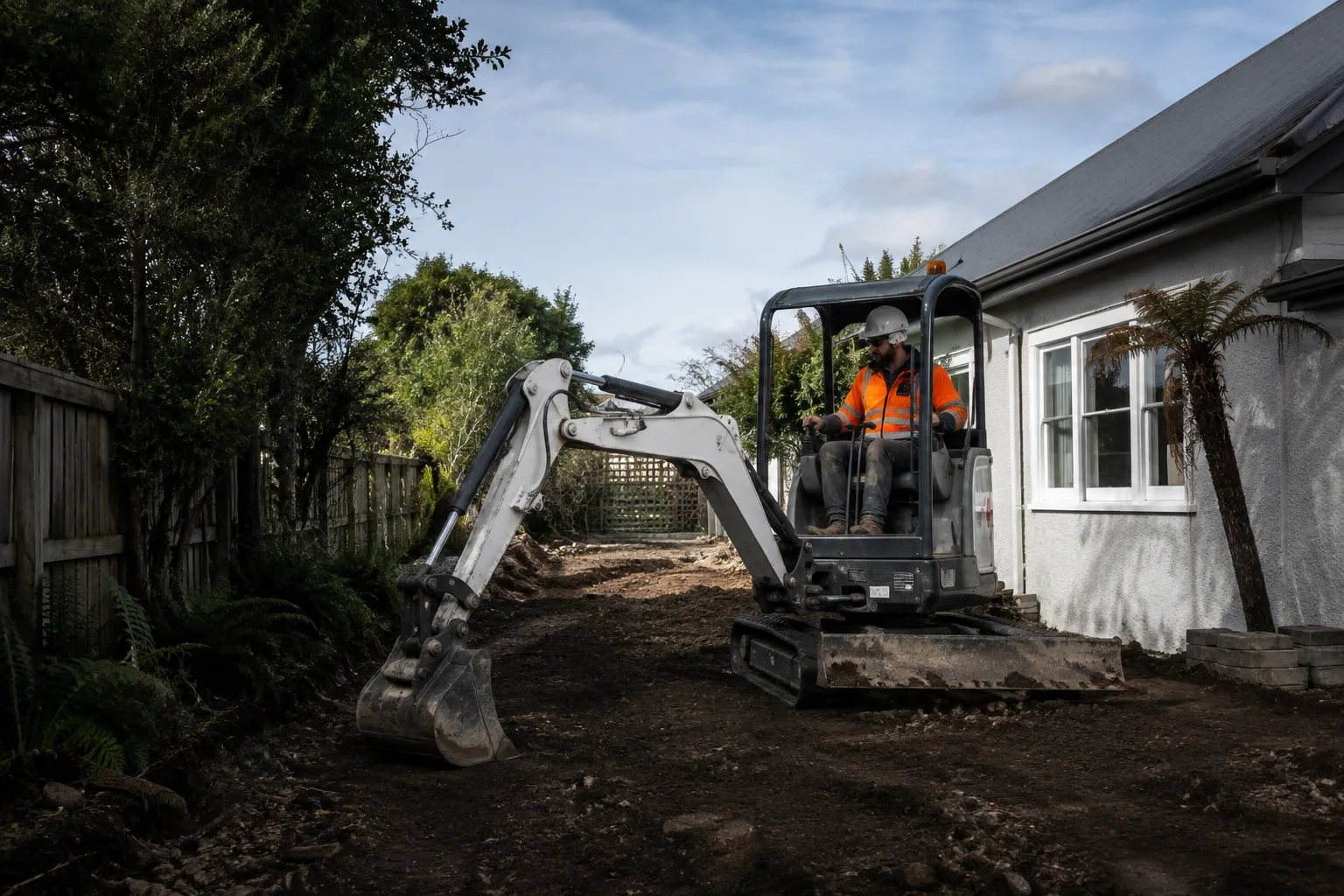
Start with the narrowest point a machine would need to pass through to reach the work area, typically a gateway, a gap between a house and fence, or a side access strip, and measure it at ground level rather than estimating by eye. Height matters too, particularly under carports, eaves, low branches or overhead power lines, since clearance needs allow for the machine's boom or cab height, not just its body. Also consider whether the machine has room to turn once through the access point, or whether it needs to reverse in and work from a fixed position, since a tight site can rule out an otherwise suitable machine on turning space alone.
Soft, wet or uneven ground favours a tracked machine with a lower ground-bearing pressure over a wheeled one, since tracks spread weight over a larger footprint and are generally more stable on slopes or soft soil. If a driveway, lawn or paved area needs to be protected from tracking damage, that is worth flagging up front, since ground mats or planned access routes can sometimes avoid unnecessary reinstatement later. Slopes also affect which machine can work safely and where spoil can be placed without it sliding or destabilising the cut face, so a description of the site's gradient is more useful to a contractor than a bare request for a digger with no further detail.
Access & machinery
Every excavator has a maximum digging depth and reach from its pivot point, and these need to comfortably cover both the depth of trench or excavation required and the distance to where spoil or a truck needs to be loaded. A machine working close to a boundary, retaining wall or existing structure also needs enough swing clearance to rotate safely without the counterweight or boom contacting anything nearby. For deeper excavations such as foundation trenches or soakage pits, dig depth becomes the limiting factor more often than bucket width, so it is worth having at least an approximate target depth in mind before requesting a quote.
WorkSafe NZ's guidance on excavation safety sets out when a trench needs shoring, battering back to a safe angle, or other edge protection, generally becoming more important as depth increases and ground stability decreases. This matters for machine selection because the safe method of digging a deeper trench, battered back rather than dug with vertical sides, often needs a wider working area at the top than the trench width alone suggests, which feeds back into the access measurements covered above. A machine chosen purely for speed without regard to how the excavation will be safely supported at depth can create a bigger problem than it solves, so safe digging practice and machine size selection are really part of the same conversation rather than separate ones.
Access & machinery
Trenching for services or drainage generally favours a machine with a narrower bucket and precise control, since the priority is a clean, accurately sized trench rather than raw volume. Bulk earthworks such as cutting and filling a building platform or subdivision lot generally suits a larger machine that can move more material per cycle, provided access allows it onto site. Tight residential sections, courtyards or rear-of-property access often call for a compact machine that trades some reach and bucket capacity for the ability to fit through a standard gateway or side access at all.
None of this is about a specific brand or model, it is about matching the job's priorities, precision, volume or access, to what a machine of that general size and configuration can realistically do.
A useful set of information to gather before contacting a contractor includes the width of every gate, gap or access point a machine would pass through, any height restrictions such as eaves, carports or overhead lines, the approximate distance from the street to the work area, the site's slope or level changes, and the rough depth and area of the excavation itself. Photos taken from a few angles, including the access route and the work area itself, help a contractor assess a site remotely and give a more accurate initial estimate. If you already know the location of underground services from a beforeUdig enquiry, having that on hand speeds up planning too.
Keep these points in mind
The right excavator size depends on access, ground conditions, working radius and the type of job, not on choosing the biggest available machine.
Measure the narrowest access point at ground level and check height clearances under eaves, carports and overhead lines before assuming a machine will fit.
Soft or sloping ground generally favours a tracked machine with a lower ground-bearing pressure than a wheeled one.
Trenching favours precision and a narrower bucket, bulk earthworks favours volume, and tight residential access favours a compact machine.
Measurements and photos of access, gradient and the work area give a contractor far more to work with than a job description alone.
A beforeUdig enquiry on known underground services helps a contractor plan working radius and dig depth safely.
Put the guide into practice
Cutting, filling and re-shaping land to bring a site to the levels your build or subdivision design calls for.
View service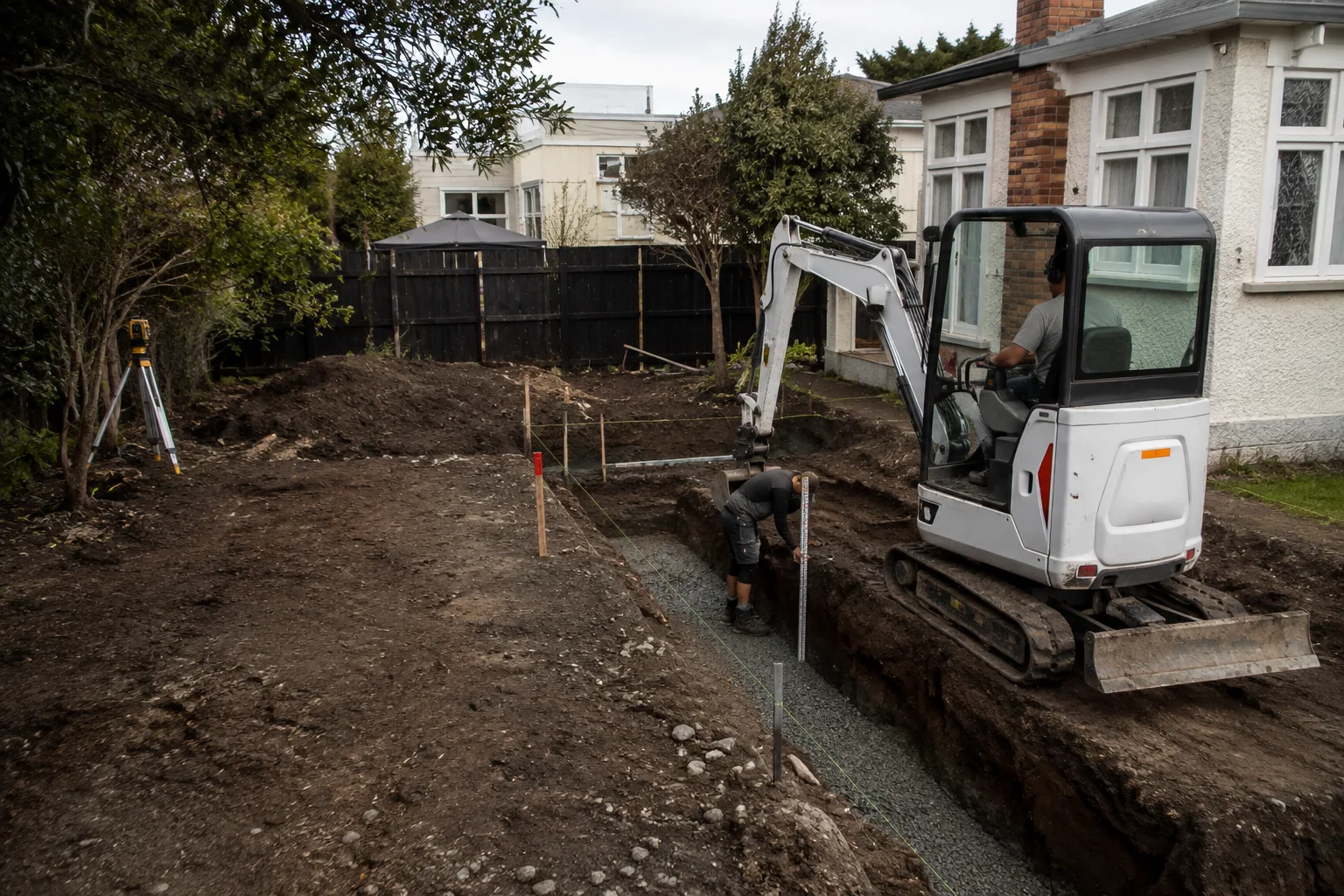
Precise excavation for foundations, footings and slabs to your engineer's drawings, with levels and depths checked before pour.
View service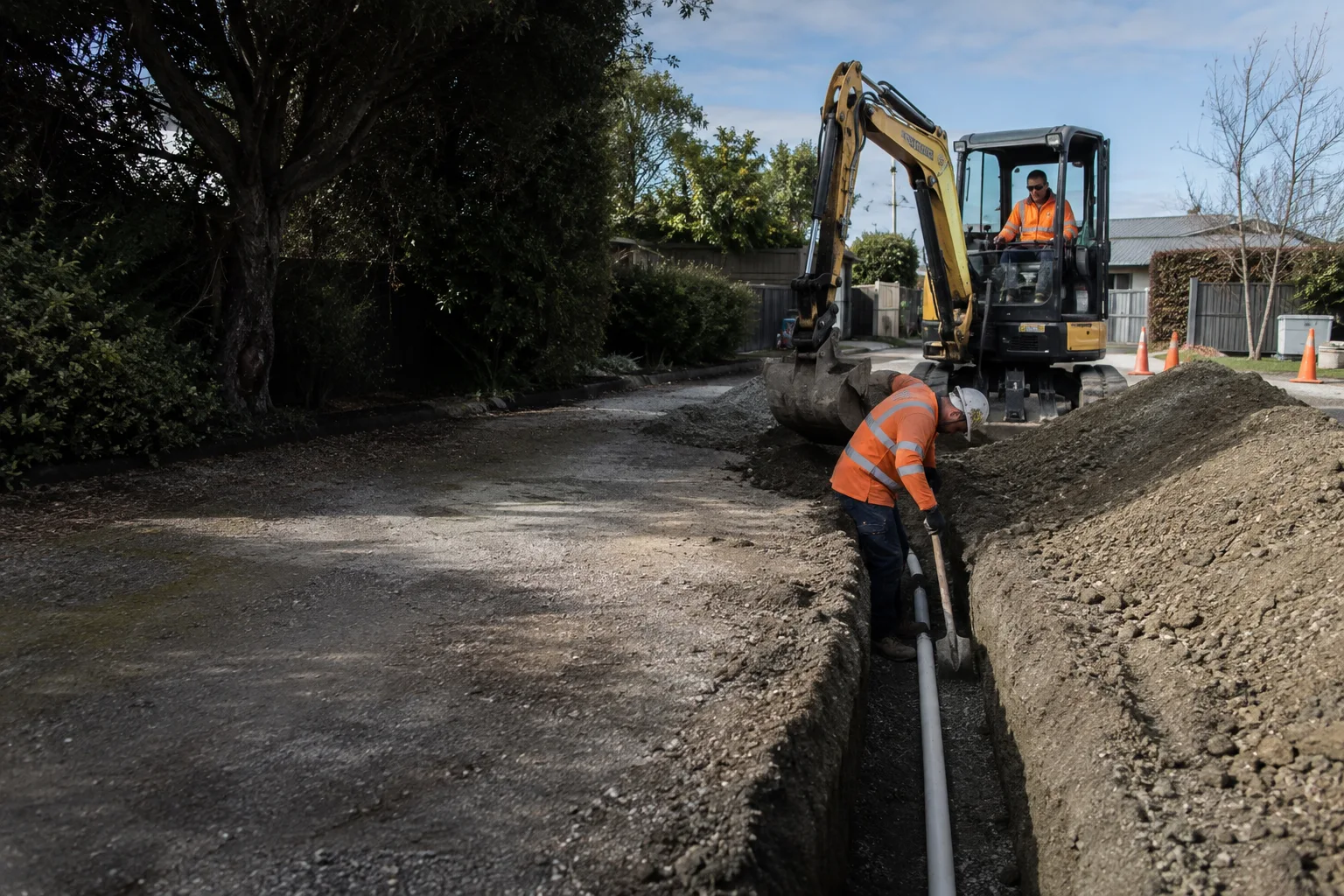
Trenching dug to depth and clearance requirements for power, water, gas or telecommunications connections, coordinated with your network provider.
View service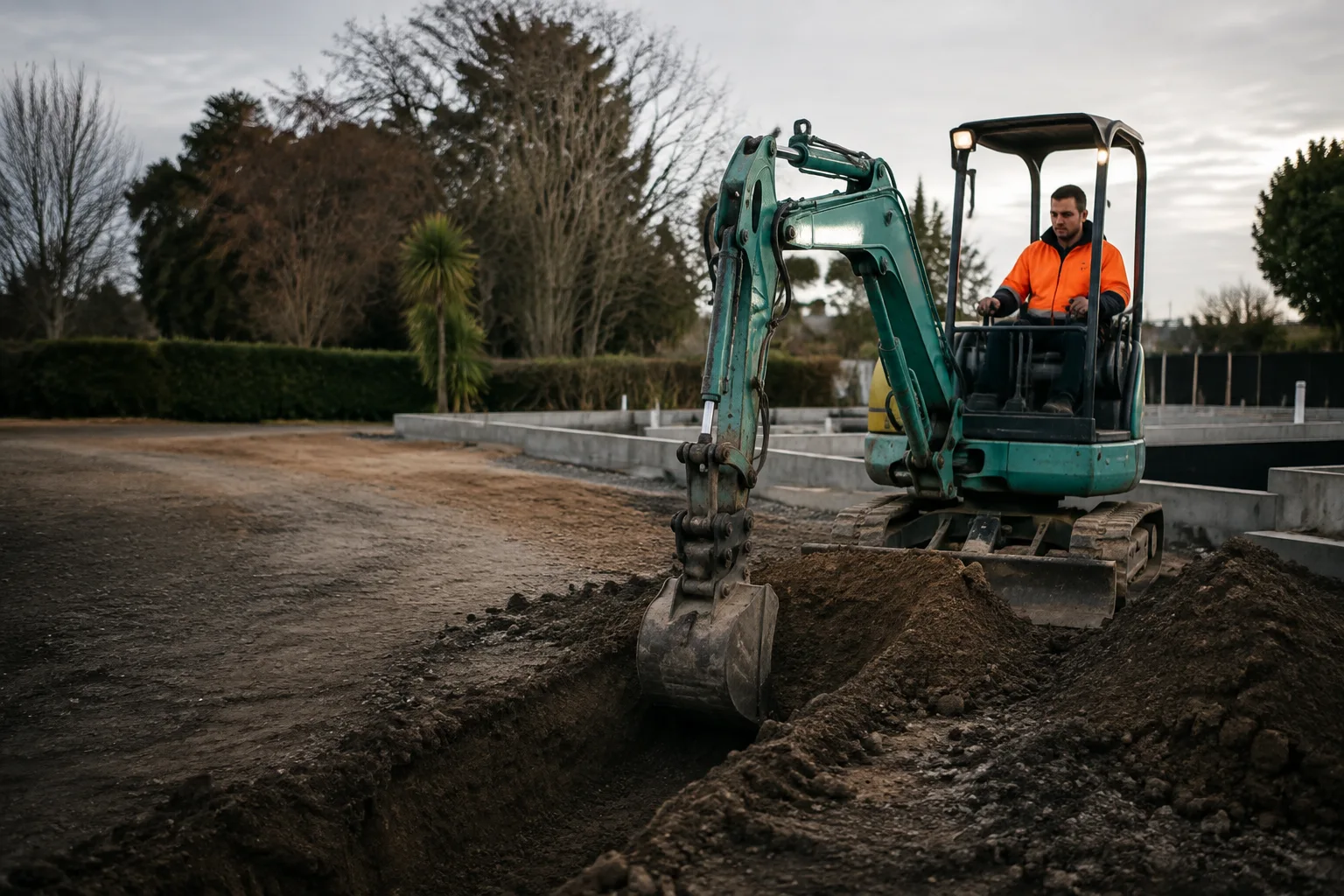
Operator-driven digger and excavator hire across Canterbury, with the machine matched to your access, ground and scope of work.
View serviceTell us about your project and we will come back with clear next steps — no pressure, no jargon.
YOUR SITE. THE NEXT CHAPTER.
Start with your suburb, a few site details and what you want to build.
Plan your project